- December 22, 2025 2:21 pm
- by Safvana
- December 22, 2025 2:21 pm
- by Safvana
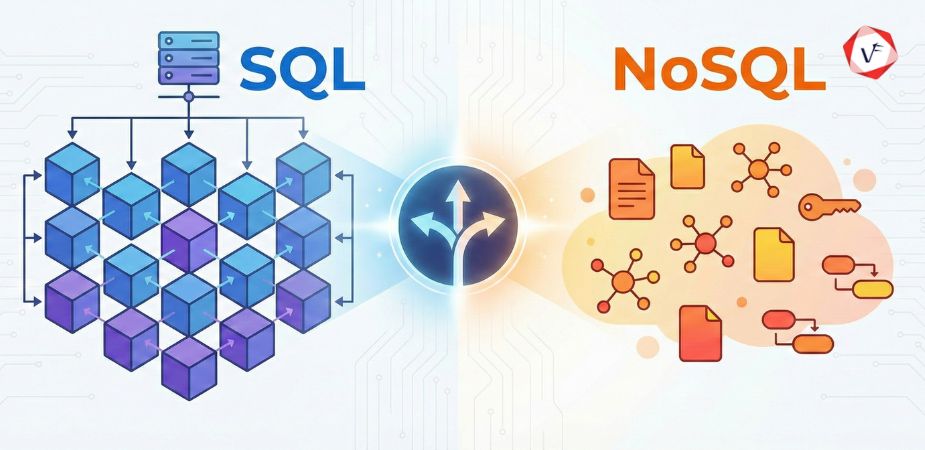
Choosing the right database is one of the most important decisions when building any software. It affects how fast your app runs, how easily it grows, and how safely your data is stored.
In today's world, two main types of databases lead the scene — SQL (relational) and NoSQL (non-relational). Both have their strengths and limitations. The choice between them depends on your project's goals, data structure, and how much flexibility or control you need.
Data is the backbone of every digital product, from a small mobile app to a large-scale enterprise system. But not all data looks the same. Some data fits neatly into tables (like customer names, phone numbers, and purchase records). Other data is messy — like product reviews, images, or user activity logs.
That's where the SQL vs NoSQL debate begins. In simple terms:
An SQL (Structured Query Language) database stores information in tables made up of rows and columns. Each table has a fixed design called a schema — it defines what kind of data each column can hold.
For example, if you're storing user information, you might have a "Users" table with columns like Name, Email, and Age.
SQL databases are called relational because they connect data between tables using relationships. They follow a set of rules called ACID — Atomicity, Consistency, Isolation, and Durability — which ensures data accuracy and reliability even when multiple people or systems are using it at the same time.
Common SQL databases include:
NoSQL stands for "Not Only SQL." Unlike traditional SQL databases, NoSQL systems don't require fixed tables or schemas. They are non-relational, meaning they can store different types of data — text, images, documents, or even complex JSON objects — all in one place.
There are four main types of NoSQL databases:
NoSQL databases are popular in modern web apps, social networks, and real-time data systems where information is constantly changing.
Understanding the fundamental differences between SQL and NoSQL databases helps you make an informed decision for your project.
Here's why SQL databases remain popular even after decades:
They maintain strong data accuracy, which is critical for industries like finance, healthcare, and e-commerce.
SQL lets you easily join, filter, and analyze data across multiple tables using simple commands.
SQL databases are stable, well-tested, and supported by a large community.
Because of defined schemas, you know exactly what kind of data can be stored — reducing errors.
SQL is a universal language. Developers worldwide understand it, making collaboration and hiring easier.
Now let's look at what makes NoSQL stand out:
You can store any type of data — from structured text to multimedia — without redesigning your schema.
NoSQL databases can handle massive data and user traffic by simply adding more servers.
For apps that require speed (like real-time chat or notifications), NoSQL can be more efficient.
Ideal for modern apps that deal with logs, user activity, or social interactions.
NoSQL allows you to make quick changes as your project evolves, without complex migrations.
Neither option is perfect — both have challenges.
Here are some simple questions to help guide your decision:
If you're building a long-term system with stable data, SQL works best. If you expect your data structure to change often, NoSQL gives flexibility.
Yes! Many modern systems use both — SQL for structured, critical data and NoSQL for large, flexible, or real-time data.
Here are some examples of where each shines:
The gap between SQL and NoSQL is closing. Many SQL databases now support JSON and flexible columns. At the same time, many NoSQL systems offer stronger data consistency and transaction support.
Some new databases even combine both models — giving developers the best of both worlds. Cloud services are also making it easier to use either option without worrying about server setup or scaling.
In 2025 and beyond, the trend will move toward multi-model databases and hybrid architectures, where teams use multiple databases for different purposes inside one system.
Yes, many systems combine them. SQL stores structured business data, and NoSQL handles flexible or large-scale data.
It depends. SQL may cost more for scaling, while NoSQL can get expensive for very large setups.
No. They serve different needs. SQL remains best for structured, transaction-based systems.
Not always. For certain complex queries, SQL can actually be faster and more efficient.
Startups that need speed and flexibility often start with NoSQL. But if your business depends heavily on reliable transactions, SQL is safer.
In 2025, the choice between SQL and NoSQL isn't about which is "better" — it's about what fits your system's needs. If you need accuracy, defined structure, and long-term consistency, SQL is a solid choice. If you need flexibility, fast scaling, and freedom to adapt, NoSQL gives you the edge.
And if you want the best of both worlds, combine them — many modern apps already do. The key is to understand your data, your growth plans, and your team's strengths. Once you do that, choosing the right database becomes simple.
At Vofox Solutions, we help businesses make the right technology decisions for their unique needs. Whether you need consultation on database architecture or complete Database Management Solutions, our team is here to guide you every step of the way.
Guaranteed Response within One Business Day!

Why the PHP2Shell Alert Makes Choosing the Right PHP Development Company More Important Than Ever

How AI-Powered UX Design Improves User Experience
When to Choose Node.js and When to Choose PHP for Your Project

How to Choose the Best Flutter App Development Company for Your Business

Key Benefits of Hiring a Flutter App Development Company in India

Guaranteed Response within One Business Day!