- March 13, 2026 1:16 pm
- by Safvana
- March 13, 2026 1:16 pm
- by Sooraj
I watched a factory floor manager try to explain to his CEO why they needed to upgrade their wireless infrastructure. The CEO kept asking: "But we already have WiFi. What's the difference?"
The manager pulled up a video of their current assembly line. Robots paused every few seconds. Quality checks happened after batches were complete. Adjustments took minutes to propagate through the system.
Then he showed footage from a competitor's factory running on 5G with edge AI. Robots coordinated in real time. Quality issues were caught and corrected instantly. The line never stopped.
That's when it clicked. This isn't about faster internet. It's about doing things that weren't possible before.
Ultra-fast connectivity used to mean downloading movies quickly. Now it means enabling entirely new ways of operating businesses.
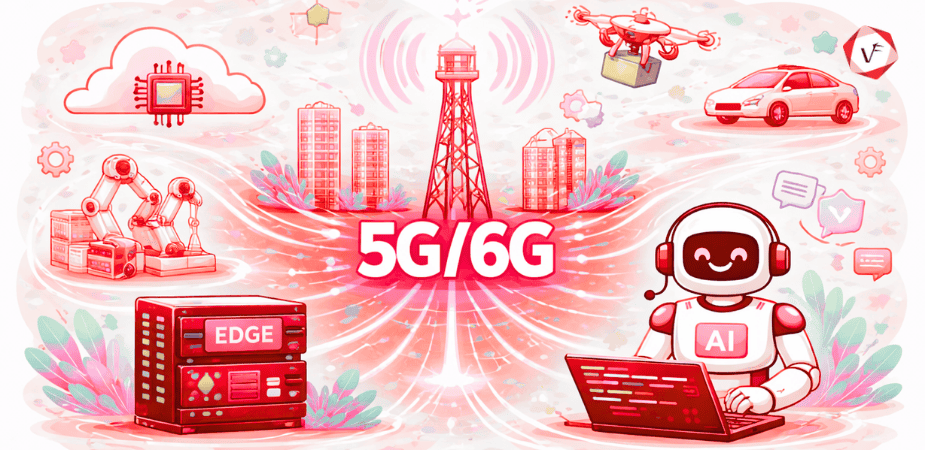
The shift happened when three things came together: networks fast enough for real-time coordination, computing power close enough to where data is generated, and AI smart enough to make decisions without human input.
Separately, each technology is interesting. Together, they're transformative.
Let's break down what we're actually talking about when we say 5G, 6G, edge computing, and AI. Not the marketing version. The practical one.
5G isn't just faster 4G. It's a different architecture designed for different use cases.
Where it matters: latency drops to under 10 milliseconds. That's the difference between a robot pausing to wait for instructions and a robot reacting instantly. It's the difference between an autonomous vehicle seeing an obstacle and actually being able to stop in time.
The capacity change is equally important. A 4G cell tower might handle a few thousand connections. 5G can handle over a million devices per square kilometer. When you're running a factory with thousands of sensors, or a logistics hub with hundreds of autonomous vehicles, this capacity matters.
6G is still being developed, but the direction is clear. Think of it as AI-native networking.
Current networks are managed by humans making decisions based on data. 6G networks will manage themselves, predicting traffic patterns, allocating resources, and optimizing performance without human intervention.
Latency will drop further, approaching one millisecond. Speeds will increase by another order of magnitude. But the real change is intelligence baked into the network itself.
Here's the problem edge computing solves: an autonomous vehicle generates about 4 terabytes of data per day. Sending all that to a cloud server for processing doesn't work. By the time the data makes a round trip, the car has already hit the obstacle.
Edge computing means running the AI model locally. The car processes camera feeds, LIDAR data, and sensor inputs right there in the vehicle. Decisions happen in milliseconds because the data never leaves.
This applies beyond vehicles. In factories, edge devices process quality control data on the assembly line. In retail stores, edge systems analyze customer behavior without sending video feeds to distant servers. In hospitals, patient monitoring happens locally with immediate alerts.
AI is what makes all this data useful. Without intelligence, fast networks and local processing just give you fast, local noise.
AI models running at the edge can:
The combination of fast networks and edge AI means decisions can happen where and when they're needed, without waiting for central systems to respond.
You could have 5G without edge computing. You could have edge computing without AI. But the real value comes from combining all three.
A warehouse with a hundred autonomous robots needs them to coordinate without collisions. Each robot is making decisions locally via edge AI. But they also need to communicate constantly about positions, routes, and priorities. That requires both the low latency of 5G and the local intelligence of edge computing.
Neither technology alone solves this. Together, they enable coordination that looks centrally planned but actually happens through distributed intelligence.
When AI runs at the edge, sensitive data doesn't leave local systems. A hospital's patient monitoring can analyze vitals without sending data to cloud servers. A retail store can track shopping patterns without uploading customer video.
The fast network allows these edge systems to coordinate and share insights without exposing raw data. You get the benefits of connected intelligence while maintaining privacy.
Sending terabytes of data to cloud servers gets expensive fast. Processing locally is cheaper. But you still need connectivity for coordination, updates, and aggregate analytics.
The combination lets you process locally while connecting globally, optimizing costs while maintaining capability.
This technology stack isn't just making existing businesses more efficient. It's enabling entirely new ways of creating value.
Cities are deploying networks of sensors and cameras connected via 5G, with edge AI processing everything locally. Traffic lights adjust to real-time flow. Energy grids balance load dynamically. Emergency services route based on actual conditions.
The business model shift: cities don't just buy infrastructure anymore. They subscribe to services. A company provides the sensors, the network, the edge computing, and the AI models. The city pays for outcomes like reduced traffic congestion or energy cost savings.
Factories are moving from buying equipment to subscribing to manufacturing capabilities. A supplier provides connected machines, edge AI for quality control, and 5G infrastructure. They guarantee output quality and uptime.
Payment is based on parts produced at quality standards, not equipment purchased. The supplier handles maintenance, updates, and optimization. The manufacturer pays for results.
Wearable devices with cellular connectivity and edge AI enable continuous health monitoring. Data is processed locally, with only significant events or trends sent to medical systems.
The business model: instead of episodic care, patients pay for continuous monitoring and early intervention. Hospitals can manage larger patient populations remotely, intervening only when edge AI detects issues requiring attention.
Companies are deploying autonomous delivery vehicles and drones that coordinate through 5G networks and make routing decisions via edge AI. They don't sell this as technology. They sell it as a logistics service.
Businesses pay per delivery or per mile, not for vehicles and infrastructure. The service provider handles the technology, maintenance, and optimization. Customers just specify pickup and delivery locations.
Physical stores are becoming intelligent environments. Edge AI tracks inventory, analyzes customer movement, adjusts displays, and personalizes offers in real time. 5G connects everything seamlessly.
Retailers aren't just selling products anymore. They're creating experiences. Some are even selling their retail intelligence platforms to other stores as a service.
Telecom companies are moving beyond connectivity. They're offering private 5G networks customized for specific uses, combined with edge computing and AI analytics.
A hospital gets a network slice optimized for medical devices, with edge AI for patient monitoring. A factory gets a slice optimized for industrial IoT, with AI for predictive maintenance. Each customer gets a customized stack, not just bandwidth.
This all sounds great in theory. In practice, there are real obstacles that businesses are hitting.
Deploying 5G infrastructure is expensive. Edge computing requires distributed hardware. AI models need development and training. The upfront investment is substantial, especially for mid-sized companies.
This is why service models are emerging. Companies that can't afford to build the stack themselves are subscribing to it from providers who amortize costs across multiple customers.
Managing 5G networks, edge infrastructure, and AI models requires specialized expertise that's in short supply. You need people who understand networking, distributed systems, and machine learning.
Many companies are partnering with technology providers rather than building these capabilities internally. It's faster and often more cost-effective than hiring and training teams.
More connected devices mean more attack surfaces. Edge computing distributes data and processing, which distributes security challenges. AI models can be vulnerable to adversarial attacks.
This requires rethinking security from the ground up. It's not enough to secure a perimeter when intelligence and data are distributed everywhere.
Equipment from different vendors needs to work together. Edge systems need to integrate with cloud platforms. AI models need to run on various hardware.
Standards are still evolving, which means early adopters sometimes face integration headaches. Waiting for maturity is safer but means missing first-mover advantages.
The trajectory is clear even if the timeline isn't. Here's where this is heading based on what's already happening in early deployments.
Networks that adjust themselves. Supply chains that reroute automatically. Factories that reconfigure based on demand. The human role shifts from operator to supervisor, reviewing decisions rather than making every one.
Virtual replicas of physical systems updated in real time through 5G sensors and edge processing. Cities will have digital twins for infrastructure planning. Manufacturers will simulate production changes before implementing them. Hospitals will model patient care scenarios.
AI systems that coordinate across organizational boundaries. A manufacturer's AI talking to a supplier's AI talking to a logistics provider's AI, optimizing the entire value chain without human intervention in routine decisions.
AR and VR that actually work because latency is low enough to feel natural. Remote collaboration that feels present. Training simulations indistinguishable from reality. This requires the bandwidth and latency that 6G promises.
Here's what matters if you're trying to figure out whether and how to invest in this technology stack.
The companies winning aren't necessarily the ones deploying every new technology. They're the ones identifying specific business problems where ultra-fast connectivity, edge processing, and AI genuinely solve something that couldn't be solved before.
A logistics company reducing delivery times by 30% through real-time routing. A manufacturer cutting defects by 60% through instant quality feedback. A hospital preventing emergencies through continuous monitoring. These aren't theoretical benefits. They're happening now.
The key is matching the technology to actual needs. Not every business needs 5G everywhere. Not every process benefits from edge AI. But where the fit is right, the impact is substantial.
If you're exploring how ultra-fast connectivity, edge computing, and AI could transform your operations, Vofox Solutions has experience helping businesses identify opportunities and implement these technologies practically. We're not trying to sell you on deploying everything everywhere. We're trying to help you figure out where these capabilities actually create value for your specific situation.
5G provides significantly higher speeds, lower latency (often under 10 milliseconds), and the ability to connect millions of devices simultaneously. Unlike 4G which was designed primarily for mobile phones, 5G enables real-time, mission-critical applications like industrial automation, remote surgery, and autonomous vehicles.
6G is currently in research and early development phases, with commercial deployment expected in the late 2020s or early 2030s. Some countries and companies are already testing early prototypes and establishing standards.
Edge computing allows AI models to process data close to where it's generated rather than sending everything to distant cloud servers. This provides faster insights (often in milliseconds), reduces bandwidth costs, improves privacy by keeping sensitive data local, and enables real-time decision-making critical for applications like autonomous vehicles and industrial automation.
Yes. Many enterprises are already using 5G networks, edge computing infrastructure, and AI for automation, analytics, and customer experience improvements. While 6G is still developing, the combination of 5G, edge, and AI is commercially available and being deployed across industries like manufacturing, healthcare, and retail.
Healthcare (remote surgery, continuous monitoring), manufacturing (Industry 4.0, predictive maintenance), transportation (autonomous vehicles, logistics), retail (personalized experiences, cashier-less stores), and telecommunications (new service models) are seeing the earliest and most significant impact.
Guaranteed Response within One Business Day!
Why Businesses Are Choosing Software Outsourcing Companies in India for AI Development

The Role of Generative AI in Modern Software Outsourcing

The Role of AI in Modern UI/UX Design

How AI Is Transforming UI/UX Design and Development in 2026

What Is Agentic AI? A Complete Guide for Businesses

Guaranteed Response within One Business Day!