- March 09, 2026 3:08 pm
- by Manek
- March 09, 2026 3:08 pm
- by Manek
A product manager I know spent six months building an AI feature for their SaaS platform. It could analyze customer data and suggest next actions. The suggestions were good. Users liked them.
But here's what kept happening: users would read the suggestion, agree it made sense, then manually go execute it. Click through three screens, fill out some fields, confirm the action. The AI knew what to do. It just couldn't do it.
That's the gap agentic AI is trying to close. Not just knowing what should happen, but actually making it happen. And building software that can do this well is harder than most people think.
Let's clear up the terminology first, because "agentic AI" is getting thrown around a lot and it doesn't always mean the same thing.
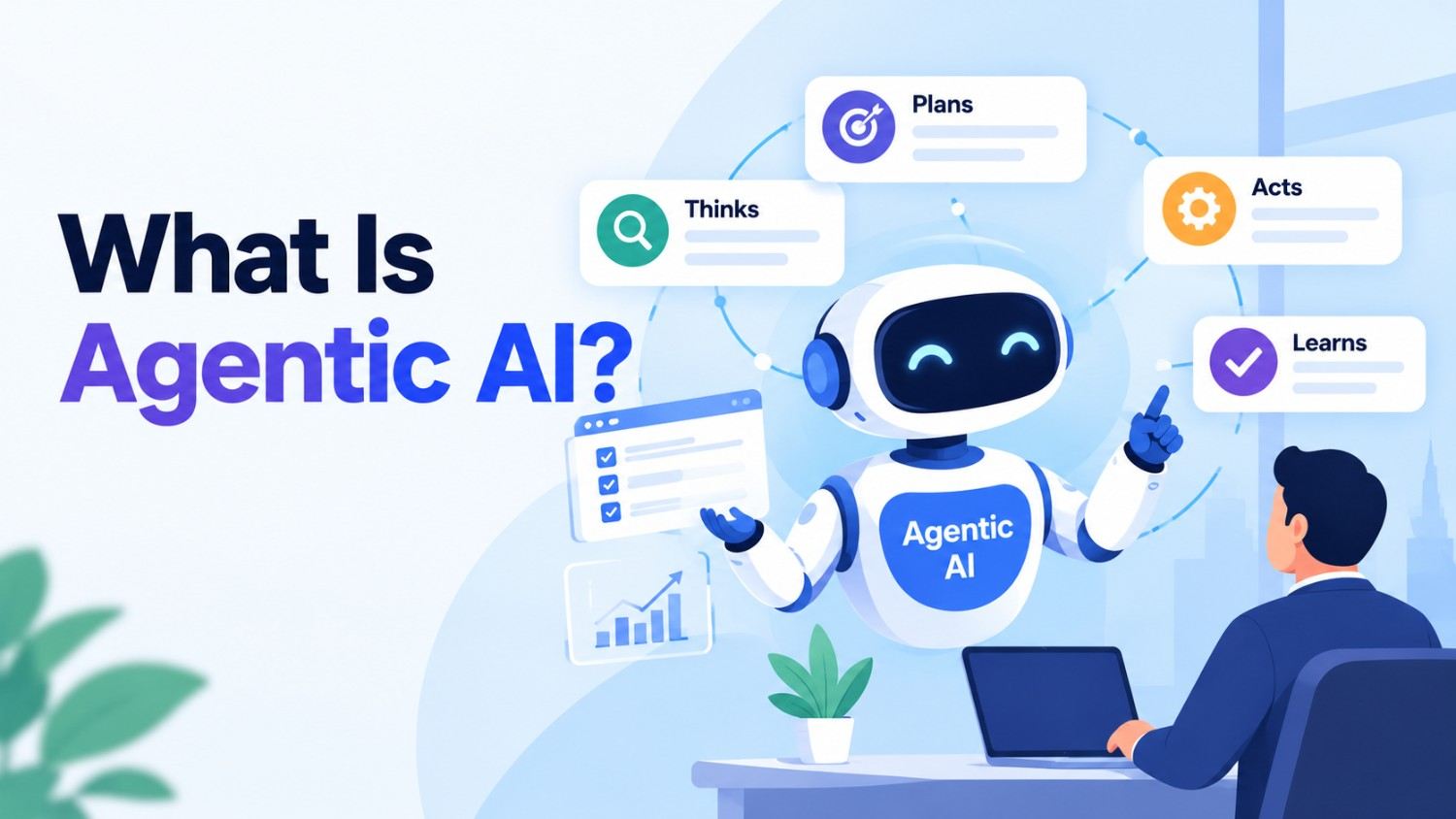
An agent, in the software sense, is a system that can perceive its environment, make decisions about what to do, take actions, and learn from the results. The key word is "actions." Not just analysis. Not just recommendations. Actual execution.
Traditional SaaS is reactive. You tell it what to do, it does it. You click a button, something happens. You fill out a form, data gets saved. The software waits for you.
Agentic AI is proactive. You give it a goal, and it figures out how to achieve it. It might need to do five different things in sequence, adapt if something doesn't work, and make judgment calls along the way. You're not micromanaging the steps.
Say you're building project management software. Traditional approach: user creates a task, assigns it, sets a due date. Each action is manual.
AI-enhanced approach: software suggests who to assign the task to based on patterns. User still clicks to confirm.
Agentic approach: user says "we need to launch the redesign next month," and the agent breaks that into tasks, figures out dependencies, assigns people based on availability and skills, sets up check-ins, and adjusts the plan when someone's timeline changes. The user reviews the plan, but the agent did the work.
That last one is what we're talking about when we say agentic AI in SaaS.
Every SaaS company is adding AI chat interfaces right now. Some of them are genuinely useful. But chat isn't the same as agentic behavior, and conflating them causes confusion.
A chatbot lets you interact with your software using natural language instead of clicking through menus. That's convenient. It lowers the learning curve. It can make complex software more accessible.
But it's still reactive. You ask, it responds. You're still driving. The software is still waiting for instructions.
An agent doesn't just respond to questions. It completes multi-step processes. It makes decisions about what to do next based on outcomes. It handles exceptions without asking you how to proceed.
You can have an agent without a chat interface. You can have a chat interface without agentic behavior. They're orthogonal concepts that happen to work well together.
If you're building or buying SaaS, understanding this difference changes what you're looking for. A chat interface is a nice-to-have feature. Agentic capability fundamentally changes how work gets done.
One is about convenience. The other is about delegation. They require different technical architectures and different trust models from users.
Building agentic AI into SaaS isn't just adding a feature. It changes the product's relationship with users in ways that ripple through everything.
Instead of doing tasks, users set goals and review results. Instead of clicking through workflows, they approve plans or adjust parameters. Instead of constant engagement, they check in periodically.
This is a big shift. Some users love it. Some feel like they've lost control. Your onboarding has to address this explicitly.
When a user makes a mistake, they know they made it. When an agent makes a mistake, who's responsible? The user for setting the wrong parameters? The software for executing poorly? The company for deploying buggy AI?
This isn't just a philosophical question. It affects how you build undo functionality, how you log actions, how you handle support requests, and potentially your legal liability.
Users need to know what the agent is doing. Not just results, but the reasoning and steps. When something's automated but opaque, trust evaporates fast.
This means your UI needs audit trails, explanation interfaces, and ways to inspect the agent's decision-making process. It's more work than just making things happen in the background.
You're not selling features anymore. You're selling outcomes. "Our software creates project plans" versus "We create project plans for you." The pricing, marketing, and competitive positioning all change.
Let's get into the messy reality of building this stuff, because it's not as straightforward as the demos suggest.
With traditional software, success is clear. Did the user's action complete? Did the data save correctly? Binary outcomes.
With agents, success is fuzzy. Did it achieve the user's goal? That depends on what the goal really was, which might not be what they explicitly stated. Did it do it well? "Well" is subjective.
You need evaluation frameworks that go beyond "did it work" to "did it work in a way users actually want." This requires ongoing testing with real usage patterns, not just unit tests.
You can't give an agent unlimited freedom. It needs constraints. But defining those constraints without making the agent useless is an art.
Too restrictive, and it can't handle the variability that makes agentic behavior valuable. Too loose, and it does things users didn't want or makes expensive mistakes.
Most teams end up with tiered permission systems. Low-risk actions can be fully automated. Medium-risk actions require user approval. High-risk actions are flagged for review. But deciding what goes in each tier requires deep product knowledge and user research.
When traditional software breaks, you can trace through the code. When an AI agent makes a bad decision, the "why" isn't always clear.
Was it the training data? The prompt? The context provided? A weird edge case the model hasn't seen before? Sometimes you genuinely don't know, and that's uncomfortable for engineering teams used to deterministic systems.
You need robust logging of not just what the agent did, but what information it had, what it considered, and what led to each decision. This data accumulates fast and requires infrastructure most SaaS companies don't have yet.
Even when it works well, users are skeptical. They've been burned by bad automation before. They've seen AI make confidently wrong statements. They're not going to hand over important work without testing it extensively.
This means your go-to-market needs to account for a trust-building period. Users will start with low-stakes tasks, watch carefully, and gradually expand usage as confidence builds. Your pricing and onboarding should facilitate this gradual adoption.
Not every SaaS product needs agentic capabilities. Sometimes simpler automation is better. Here's where agentic approaches genuinely add value.
If your users are doing the same sequence of actions over and over, just with different data, that's a candidate. Onboarding new customers, processing applications, managing incidents. The pattern is consistent enough to automate but variable enough that simple rules don't work.
Traditional automation breaks on exceptions. Agentic systems can reason through them. If 80% of cases are straightforward and 20% need judgment, an agent can potentially handle both.
This is particularly valuable in areas like customer support, content moderation, or compliance review where exceptions are common and important.
When things need to happen at specific times or in response to events, and humans can't be constantly monitoring, agents make sense. Security responses, inventory management, campaign optimization. The agent watches and acts when conditions are met.
Tasks that require pulling information from multiple sources, making sense of it, and taking action based on the synthesis. Market research reports, risk assessments, personalized outreach. The agent does the research and executes the follow-up.
Simple, deterministic tasks where traditional automation works fine. Highly creative work where human judgment is the whole point. Anything where the stakes are so high that users want manual control over every decision.
And definitely not "because everyone else is doing it." That's how you end up with agents nobody uses.
If you're adding agentic AI to your SaaS product, here's what seems to matter based on what's working and what's failing.
Show users what the agent is doing. Not buried in logs, but visible in the interface. "I analyzed these three options and chose this one because..." type transparency.
Users should be able to trace any action back to the reasoning. This isn't just for debugging. It's how users learn to trust the system.
For anything that matters, have the agent propose and the user approve. This gives users a sense of control while still saving them the work of figuring out what to do.
Over time, users might choose to auto-approve certain types of actions. But that should be their choice, not the default.
Big red button functionality. Users need to know they can always take control back. The agent should gracefully hand off and preserve context when this happens.
This isn't just a safety feature. It's a psychological safety net that makes users more willing to try automation.
Every action, every decision point, every piece of context used. You'll need this for debugging, for user support, potentially for compliance, and definitely for improving the system over time.
Storage is cheap. Regret about missing logs is expensive.
Don't try to make your entire product agentic overnight. Pick one workflow. Get it working reliably. Learn what users like and what they're nervous about. Then expand.
The companies doing this well are patient. They're building confidence through demonstrated reliability, not through marketing promises.
Here's what a lot of SaaS founders are asking: if we don't add agentic AI, will competitors eat our lunch?
Maybe. But it's not as simple as "first mover wins."
Enterprise buyers especially aren't rushing to adopt agentic systems. They want proven reliability. They want clear accountability. They want to see it work for someone else first.
Being second or third with a really solid implementation might beat being first with something half-baked.
Some users want maximum automation. Others want to maintain control. Building for both, with clear controls about how much the agent can do autonomously, might be smarter than going all-in on full automation.
An agent that works seamlessly with the rest of your product beats a powerful agent that feels bolted on. Users care more about whether the automation actually fits their workflow than whether it uses the latest AI model.
If you rush out agentic features that aren't reliable, you can damage trust in your entire product. Users who get burned by bad automation don't just turn off the feature. They start questioning whether they should use your product at all.
Careful execution beats fast execution here. This is one of those moments where the second-mover advantage is real.
Agentic AI is going to be table stakes for certain categories of SaaS. Not because it's hyped, but because once users experience having software that actually completes tasks instead of just facilitating them, they won't want to go back.
But the companies that win won't be the ones that slap AI agents onto existing products. They'll be the ones that rethink their products from the ground up around this new capability.
What does your product look like if users don't click through every action? What changes if they're reviewing plans instead of creating them? What new use cases become possible if the software can work while they're not watching?
These aren't incremental questions. They're fundamental product strategy questions. And they don't have obvious answers yet because we're still figuring out what works.
The teams building this well are doing it thoughtfully. They're starting with real user problems, not technology looking for problems to solve. They're building trust gradually. They're being transparent about limitations. They're treating this as product evolution, not marketing differentiation.
If you're trying to navigate this shift and want help from people who've actually built these kinds of systems in production, Vofox Solutions has experience with both the AI side and the SaaS product side. We're not trying to convince you to add agentic AI everywhere. We're trying to help you figure out where it actually makes sense and how to build it in a way users will trust. Sometimes that means going all-in. Sometimes it means starting small. Sometimes it means waiting until you have the right use case. We can help you figure out which is which.
Guaranteed Response within One Business Day!
Why Businesses Are Choosing Software Outsourcing Companies in India for AI Development

The Role of Generative AI in Modern Software Outsourcing
The Role of AI in Modern UI/UX Design
How AI Is Transforming UI/UX Design and Development in 2026
What Is Agentic AI? A Complete Guide for Businesses

Guaranteed Response within One Business Day!