- January 22, 2026 6:19 pm
- by Safvana
- January 22, 2026 6:19 pm
- by Safvana
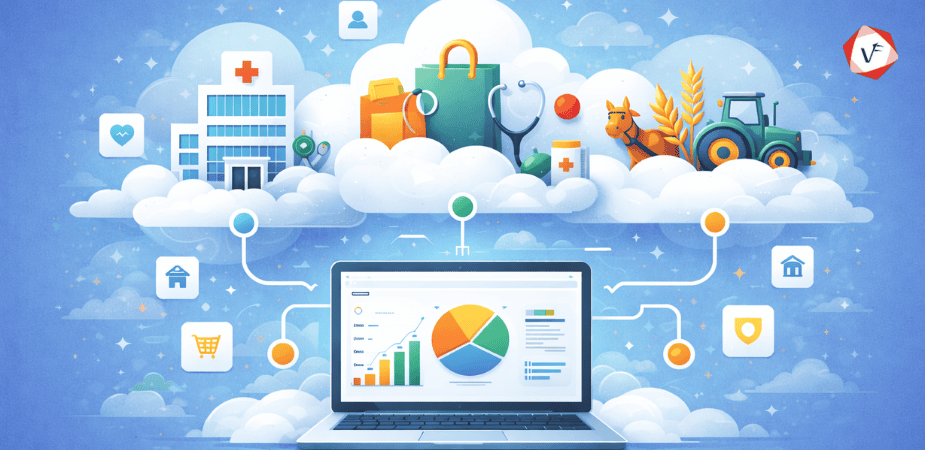
You've probably used a dozen SaaS tools. Email, project management, video calls. They work fine for general tasks.
But what happens when you need software that actually understands your industry? When you're running a dental clinic and your practice management tool doesn't know the difference between a crown and a cleaning? When you're managing construction projects and your software has never heard of change orders?
That's the gap vertical SaaS fills. Instead of building software for everyone, it builds software for someone specific. Your industry. Your workflows. Your compliance headaches.
In 2025, more businesses are ditching one-size-fits-all solutions for tools that actually speak their language. And the shift is happening faster than most people realize.
Vertical SaaS is cloud-based software built for one specific industry.
Not "software that kind of works for healthcare." Software designed exclusively for healthcare, with features that only make sense in that context. Patient scheduling, HIPAA compliance, insurance billing, clinical documentation. A hospital administrator opens it and immediately recognizes their world.
The same applies to construction, legal services, restaurants, real estate, agriculture. Each industry has unique processes that generic software struggles to handle well. Vertical SaaS starts with those industry-specific needs and builds everything around them.
A few examples to make this concrete:
A practice management platform built only for law firms, understanding billable hours, case management, and trust accounting. A property management system designed specifically for real estate companies, handling tenant screening, lease agreements, and maintenance requests. A restaurant point-of-sale system with table management, kitchen display integration, and menu engineering tools.
The key difference isn't just features. It's focus. Vertical SaaS companies become experts in one domain instead of trying to serve everyone adequately.
Horizontal SaaS casts a wide net. Think Google Workspace, Slack, Zoom, Salesforce. Useful across industries because they solve universal problems. Everyone needs email. Everyone needs communication. Everyone manages customers somehow.
Vertical SaaS goes narrow and deep. Veeva Systems doesn't care about retail or manufacturing. It's built for pharmaceutical companies and life sciences. Procore isn't interested in law firms. It's construction management through and through.
The trade-off is straightforward:
Horizontal SaaS reaches millions of potential users across countless industries. It needs to stay generic to remain useful everywhere. Vertical SaaS serves a smaller audience but solves their problems better because it's not compromising for other industries.
When you're choosing software, this matters. Horizontal tools offer flexibility and broad compatibility. Vertical tools offer precision and industry expertise. Neither is inherently better. It depends on what you're trying to solve.
If your needs are general, horizontal works great. If your industry has specific workflows, compliance requirements, or terminology that generic software fumbles, vertical is probably worth the switch.
Vertical SaaS isn't new, but it's having a moment. Several forces are driving this.
First, businesses got tired of "configuring" generic software to fit their workflows. You buy a CRM, spend months customizing it, hire consultants, build integrations, and still end up with something that feels like a compromise. Industry-specific tools eliminate most of that friction because they're built around how your business actually operates.
Second, compliance got complicated. Healthcare has HIPAA. Finance has PCI-DSS and SOC 2. Education has FERPA. Legal has attorney-client privilege requirements. Generic software treats compliance as an afterthought, leaving businesses to figure it out themselves. Vertical SaaS bakes it in from day one.
Third, cloud computing and AI made building specialized software more feasible. It's easier now to create industry-specific features, integrate with niche tools, and scale without massive infrastructure investments. The barriers to building vertical SaaS have dropped considerably.
Fourth, data became everything. Businesses don't just want reports. They want insights relevant to their industry. A restaurant owner cares about table turnover rates and food cost percentages. A construction manager cares about project burn rates and subcontractor performance. Generic analytics don't speak that language. Vertical SaaS does.
Finally, ROI became more measurable. When software solves exact problems instead of offering broad capabilities you might use someday, value becomes obvious faster. Adoption improves. Training time drops. Teams actually use the features instead of working around them.
All of this creates a perfect environment for vertical SaaS to thrive.
The advantages of vertical SaaS come from specialization.
Better fit right out of the box. You're not molding generic software to your needs. It already works the way your industry works. The terminology is familiar. The workflows make sense. Your team recognizes what they're looking at.
Built-in compliance. Instead of worrying whether your software meets regulatory requirements, it's designed around them. HIPAA compliance for healthcare. GDPR for European operations. Industry-specific audit logs, data retention policies, access controls. It's there by default.
Faster implementation. Generic software requires extensive configuration. Vertical SaaS requires less because the foundational workflows already match your industry. You're tweaking details, not rebuilding processes.
Relevant analytics and insights. You get KPIs that actually matter to your business. Not generic metrics you have to translate. Industry-specific dashboards showing the numbers you check every day.
Support that understands your business. When you call support, they know your industry's terminology and common issues. You're not explaining what a change order is or why patient no-shows matter. They already know.
Higher retention rates. When software fits perfectly, businesses rarely switch. The switching costs are higher because you'd need to find another industry-specific tool, not just any project management platform. This benefits vendors, but it also means more stable, mature products for users.
These benefits compound over time. The initial setup is easier, ongoing usage is smoother, and long-term value is clearer.
Vertical SaaS solves specific problems well, but it comes with constraints.
Smaller user base. Serving one industry means fewer potential customers than horizontal SaaS. This limits growth potential and sometimes affects pricing. Vendors need higher prices per customer to be sustainable.
Development costs can be higher initially. Building software that truly understands an industry requires deep research, domain expertise, and specialized features. That investment takes time and money upfront.
Scaling is tricky. Expanding to new industries means essentially building new products. You can't just translate your restaurant software into construction software. The domains are too different. Geographic expansion also brings challenges because industries operate differently across countries.
Industry dependence creates risk. If your target industry faces a downturn or regulatory changes, it directly impacts your software business. You're tied to the health of one sector rather than diversified across many.
Less flexibility for edge cases. Because vertical SaaS is opinionated about workflows, businesses with unusual processes might struggle. Horizontal tools are more adaptable to weird requirements because they're built to be configurable.
These aren't dealbreakers. They're just realities of the vertical approach. For businesses whose needs align well with a vertical solution, the benefits outweigh the limitations. For those with unique requirements or multi-industry operations, horizontal might still make more sense.
Examples help clarify what vertical SaaS looks like in practice.
Veeva Systems serves pharmaceutical and life sciences companies exclusively. Clinical trial management, regulatory compliance, commercial operations. Everything is built around how drug companies operate. They've become the standard in their industry because they understand it better than anyone else.
Procore focuses entirely on construction. Project management, financials, quality and safety, field productivity. Contractors, builders, and project managers use it because it speaks construction fluently. General project management tools don't handle construction-specific workflows like RFIs, submittals, and daily logs.
Clio is practice management software for law firms. Time tracking, billing, case management, client communication, trust accounting. Built around the legal profession's unique requirements and ethical obligations.
Toast serves restaurants with point-of-sale, online ordering, delivery management, kitchen display systems, and restaurant-specific reporting. It understands table management, menu engineering, and the operational chaos of food service.
CureMD provides healthcare practices with electronic health records, practice management, billing, and patient engagement. Designed around medical workflows and healthcare compliance from the ground up.
Each of these companies chose to be the best at serving one industry instead of being adequate for many. That focus created products people in those industries actually want to use.
Choosing industry-specific software requires different evaluation than generic tools.
Start by mapping your actual needs. What are your biggest operational headaches? Compliance challenges? Workflow bottlenecks? Find software that addresses those specific issues, not just software marketed to your industry.
Check integration capabilities. Even vertical SaaS needs to work with other systems. Your accounting software, payroll, CRM, communication tools. Make sure the vertical solution connects smoothly with your existing stack.
Verify compliance and security features. This is where vertical SaaS should shine. Does it support the regulatory requirements for your industry and region? Can it handle data sovereignty rules if you operate internationally?
Evaluate scalability realistically. Will this software grow with you? Can it handle multiple locations, increased users, expanded service lines? Just because it's industry-specific doesn't mean it should limit your growth.
Look for industry reviews and case studies. How do other businesses in your sector rate this product? What do they say about implementation, support, and long-term satisfaction? Industry-specific reviews matter more than general software review sites.
Test the actual workflow. Don't just watch demos. Get hands-on. Walk through your daily processes in the software. Does it actually make things easier, or does it just look nice in presentations?
Consider vendor stability and roadmap. Since you're investing in specialized software, you want a vendor that will be around and actively improving. Check their funding, growth trajectory, and product roadmap.
The right vertical SaaS should feel like it was built for how you actually work, not how software companies think you should work.
Not all vertical SaaS is created equal. The successful platforms share certain characteristics.
Industry workflows built in. The software mirrors how your industry actually operates. Patient scheduling for healthcare. Loan processing for finance. Tenant onboarding for real estate. These aren't add-ons or customizations. They're fundamental to the product.
Compliance baked into the architecture. Audit trails, data encryption, role-based access, automated compliance reporting. Security and regulatory features that match industry standards like HIPAA, GDPR, PCI-DSS, or SOC 2. This isn't bolted on later. It's part of the foundation.
Deep integrations with industry tools. The software connects seamlessly with other platforms common in your industry. EHR systems for healthcare. Accounting platforms for retail. POS systems for hospitality. ERP systems for manufacturing. These integrations reduce manual data entry and improve accuracy.
Configurable but not complex. Every business is slightly different, even within the same industry. Good vertical SaaS offers customization options without requiring technical expertise. Dashboards, workflows, templates, permissions. Flexible enough to adapt, structured enough to be useful immediately.
Industry-relevant analytics. Reports and dashboards showing KPIs that matter to your sector. Patient satisfaction scores for healthcare. Inventory turnover for retail. Project burn rates for construction. Not generic metrics you have to interpret.
Robust security architecture. Because vertical SaaS often handles sensitive industry data, security can't be an afterthought. Two-factor authentication, encryption, intrusion detection, secure APIs, regular security updates. This builds trust and protects critical information.
Genuine scalability. The platform should handle growth without breaking. More users, higher data volumes, multiple locations, expanded services. Scalability ensures the software remains valuable as your business evolves.
Automation of repetitive work. Appointment reminders, inventory alerts, document approvals, payment notifications. Vertical SaaS should automate industry-specific tasks that consume time without adding value.
Support with industry knowledge. Customer support teams that understand your business context. They know your terminology, common issues, and industry best practices. This makes problem resolution faster and training more effective.
When vertical SaaS includes these elements, it becomes indispensable rather than just useful.
The trajectory of vertical SaaS points toward even deeper specialization.
AI will make industry-specific platforms smarter. Predictive analytics tailored to your sector. Automation that understands industry nuances. Personalized recommendations based on patterns within your industry, not generic usage data.
Micro-vertical SaaS is emerging. Instead of "healthcare software," we're seeing "dental clinic software" or "pediatric practice software." Instead of "real estate software," it's "vacation rental management software" or "commercial property software." As markets mature, specialization increases.
Global adoption is accelerating, especially in emerging markets. Asia, the Middle East, Africa, Latin America. These regions are adopting cloud technology rapidly and demanding industry-specific solutions that match local regulations and business practices.
Data sovereignty and localization will shape vertical SaaS development. As countries introduce data protection laws, vertical platforms will need region-specific compliance features. Software that works globally while respecting local requirements.
Industry collaboration will increase. Vertical SaaS vendors will partner more with industry associations, regulatory bodies, and other technology providers to create comprehensive ecosystems rather than standalone products.
By 2030, most businesses will likely rely on at least one vertical SaaS platform as a core operational system. The days of trying to force generic software into industry-specific workflows are ending. Specialization is winning.
If you're building software or running a business, understanding this shift matters. The question isn't whether vertical SaaS will grow. It's how quickly your industry will adopt it and whether you'll be early or late to the transition.
For businesses exploring vertical SaaS development or looking to transition from generic tools to industry-specific platforms, Vofox Solutions specializes in building custom SaaS applications that understand specific industry needs. Whether you need compliance-ready healthcare software, construction management tools, or solutions for any other vertical market, we bring deep technical expertise and industry understanding to every project. Get in touch to discuss how we can help build or optimize your industry-specific software solution.
What does Vertical SaaS mean?
Vertical SaaS is cloud-based software designed specifically for one industry or niche. Unlike general SaaS tools that serve everyone, vertical SaaS focuses on the unique workflows, compliance needs, and challenges of a particular sector like healthcare, construction, or legal services. It's deep specialization instead of broad applicability.
How does Vertical SaaS differ from Horizontal SaaS?
Horizontal SaaS serves many industries with general-purpose tools, like Slack or Zoom. Vertical SaaS targets one specific industry with deep, specialized features. Think broad reach versus deep specialization. Horizontal tools work everywhere but aren't optimized for anywhere. Vertical tools work perfectly for one sector.
Why is Vertical SaaS important in 2025?
Businesses now demand software that truly understands their industry-specific operations, compliance requirements, and workflows. Generic tools often fall short when dealing with specialized needs, making vertical SaaS the smarter choice for focused solutions. The complexity of modern business operations requires precision, not generic flexibility.
What are examples of Vertical SaaS platforms?
Popular examples include Procore for construction management, Clio for legal practices, Veeva Systems for pharmaceuticals, Toast for restaurants, and CureMD for healthcare. Each platform specializes deeply in its respective industry, offering features and workflows that generic software can't match.
Is Vertical SaaS suitable for small businesses?
Absolutely. Small businesses often benefit most because these tools are built to match their exact operations and challenges. They get industry-specific features without paying for unnecessary broad functionality. Implementation is faster, training is easier, and ROI is clearer because the software fits their needs precisely.
Vertical SaaS represents precision over popularity.
Instead of building software that works for everyone, it builds software that works perfectly for someone specific. Your industry. Your workflows. Your compliance requirements. Your actual daily operations.
The shift toward vertical SaaS isn't a trend. It's a fundamental change in how businesses think about software. Generic tools served a purpose when options were limited and customization was expensive. Now, with cloud computing, AI, and specialized development expertise widely available, businesses can choose software that actually understands their world.
The companies that adopt vertical SaaS early gain advantages in efficiency, compliance, and operational insight. The vendors that build it well create defensible market positions because switching costs are high when software truly fits.
Whether you're evaluating vertical SaaS for your business or considering building it for your industry, the core principle remains the same: specificity wins when execution matters. And in 2025, execution matters more than ever.
Guaranteed Response within One Business Day!

Why the PHP2Shell Alert Makes Choosing the Right PHP Development Company More Important Than Ever

How AI-Powered UX Design Improves User Experience
When to Choose Node.js and When to Choose PHP for Your Project

How to Choose the Best Flutter App Development Company for Your Business

Key Benefits of Hiring a Flutter App Development Company in India

Guaranteed Response within One Business Day!