- August 19, 2026 11:35 am
- August 19, 2026 11:35 am
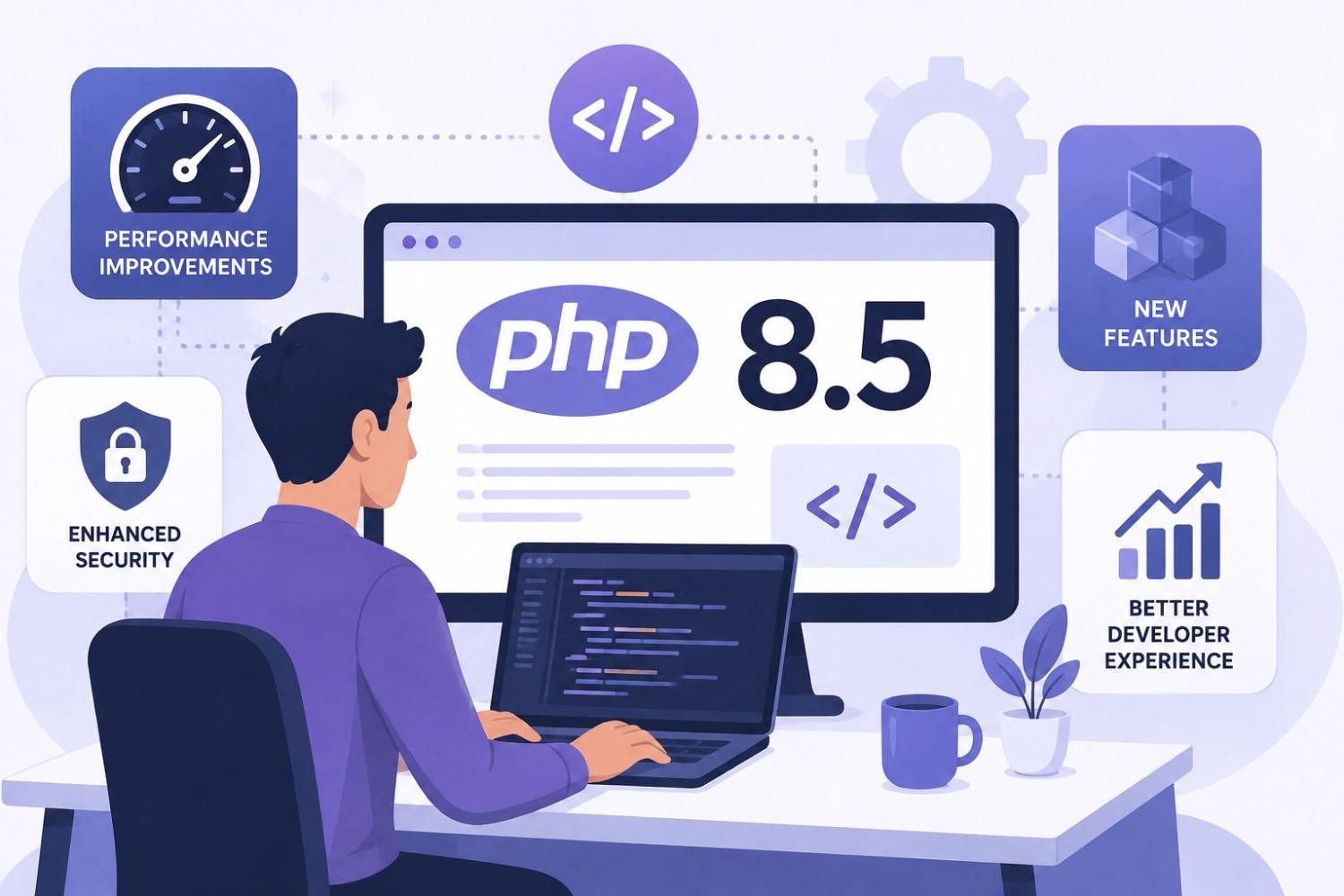
PHP's new update, called PHP 8.5, launched on November 20, 2025, introduces a mix of new capabilities and deprecated features that most teams won't have time to completely read and understand. This happens because most companies running PHP applications are busy dealing with sprint deadlines, and a small upgrade like PHP 8.5 can get pushed back until something serious happens like an audit finding, a security patch deadline, or a vendor dropping support for an older version. A PHP web development company in India, or any partner that lives in this stack daily, catches these changes before they become emergencies. This article is all about what's new in the PHP 8.5 release, and what it means for businesses trying to decide when and how to upgrade the old PHP systems properly.
PHP shows up everywhere in business tech, from CMS and custom internal tools to e-commerce platforms and other business-critical applications built anywhere from five to six years ago to now. Keeping it updated often helps businesses with faster system performance, fewer bugs, robust security, and lower long-term maintenance expenses. The current stable version is PHP 8.5, which is a minor release when compared to other software upgrade notifications. But the timeline of the release is something that needs attention. PHP 8.5 will remain in active bug support until December 31, 2027, and will continue receiving security updates until December 31, 2029. There's enough bandwidth for companies to plan the upgrade at their own pace but waiting and skipping is not an option here. This is where collaborating with a PHP web development company in India can help businesses get the most out of each update. If left unnoticed, these small, deferred updates can pile up gradually over time, and by the time a business is forced to act, whether by a security audit, a client requirement, or a vendor pulling support, it's no longer a simple update. It's a full-blown migration project with far more risk and cost attached.
PHP 8.5 is not a random update released by PHP and it’ not going to reinvent the language. It fixes a few things developers have complained about for years. Here's are the handful of things that stands out in PHP 8.5 release: Pipe operator (|>) This is the headline feature. It allows developers to chain function calls left-to-right instead of nesting them: // Before $result = strtoupper(trim(str_replace(' ', '-', $input))); // After (PHP 8.5) $result = $input |> fn($s) => str_replace(' ', '-', $s) |> trim(...) |> strtoupper(...);
Each step passes a single value to the next callable, so the code reads in the same order as things actually happen rather than working from inside out to figure out what runs first. Users will never see these changes, but developers love this and will be familiar to anyone who has used pipes in JavaScript.
Next feature that’s worth mentioning is the addition of a new URI (Uniform Resource Identifier) extension as a standards-compliant parser for both RFC 3986 and the WHATWG URL standard, built into the standard library. Previously, developers relied heavily on parse_url() (which is fairly limited) or third-party libraries for managing URLs properly.
clone() with property overrides
Clone becomes a function-like clone() that accepts a second array argument to adjust properties on the cloned object, calling __clone() before assignments while respecting visibility and property hooks.
Example: readonly class User { public function __construct( public string $name, public bool $isAdmin = false, ) {} public function asAdmin(): self { return clone($this, ['isAdmin' => true]); }
This is a big win for the "wither" pattern common with read-only classes/DTOs.
#[\NoDiscard] attribute
This attribute warns when a return value isn't used, helping prevent mistakes and improve API safety. It is relatively more useful for functions where ignoring the return value is almost always a bug (e.g., functions returning error codes or immutable results).
array_first() and array_last() are new functions many developers assumed already existed for grabbing the first/last value of an array without reset()/end() gymnastics. These small functions remove the daily friction developers have quietly worked around for years.
Closures in constant expressions & Closure: :getCurrent()
PHP 8.5 now also allows developers to use closures in constant expressions, so you can, for instance, set up a default attribute value to a Closure. It also adds recursion support for closures with a new static Closure: :getCurrent() method. This replaces the old workaround of binding a variable reference into the closure just so it could call itself.
Other notable additions
First-class callable syntax is now allowed in constant expressions (e.g., 'strtolower'(...)).
curl_multi_get_handles() lets you retrieve all easy handles attached to a multi handle, handy for debugging.
Better fatal error stack traces, expanded asymmetric visibility to static properties, and various DOM/Exif extension improvements for HTML5 and modern image format support.
These are worth adopting and to avoid the complexities, a good PHP web development company in India can handle the migration for you. They will have specialized consultants who can audit your PHP application's codebase, flag anything that might break your system, and get you onto the 8.5 version without any struggle.
For large-scale businesses, migrating an old PHP application or system to PHP 8.5 may sound scary and complicated, but with an experienced firm, all this comes down to small, careful steps. If you don't have a partner, try to understand the significance of the release, look at the new features, and wait for the official patch release. Then start by checking your current PHP version and reading through the guide to see what changed and what got removed. Update your Composer dependencies one by one based on the newest features, fix the deprecated code the error logs flag, and test every part of your application on a staging server before going live. And keep a backup plan ready, just in case. If your internal team is not equipped for this transition, then partnering with a reliable PHP web development company in India can make the migration process faster, cheaper and less risky.
PHP 8.5 is one of many PHP releases, and there's already more on the way. Making changes and staying current is not a herculean task; it's just a matter of going step by step, testing properly, and keeping a rollback plan handy in case things go sideways. Whether you handle it in-house or bring in a trusted PHP web development company in India, the goal stays the same: a smooth, low-risk move without destructing the entire system. And since PHP 8.6 is already out, keep an eye on our blogs for the latest updates in the PHP world.
What are the major new features in PHP 8.5?
PHP 8.5 brings a novel experience to the developers with the inclusion of the new pipe operator for chaining functions. Next is the addition of two URLs parsing classes build exclusively on RFC 3986 and WHATWG standards. Another outstanding capability is the reworked clone syntax that updates properties during the cloning. There's also a new #[\NoDiscard] capability that warns developers when a function’s return value remains unused, which often becomes the bug. The version also adds array_first(), array_last(), get_error_handler(), and get_exception_handler() and it also makes OPcache a permanent part of every PHP build from now on.Is PHP 8.5 better than PHP 8.4 for business applications?
For most teams, the answer could be yes but "better” here means smother developer experience and cleaner code. The PHP 8.5 release is all about improving the ergonomics of everyday coding and tightens up the issues that developers have been raising for years. If your business relies on custom PHP code that works mainly on URLs, cloning, or array handling a lot, the new features can genuinely reduce issues like boilerplate and bugs. But if your app runs stable on 8.4 version and doesn't need any of these features, there’s no need to convert your old version into this immediately. Consider this release more of a quality-of-life upgrade than a must-have.Should businesses upgrade their existing PHP applications to PHP 8.5?
Yes. But businesses can plan it based on a convenient timeline rather than choosing a sudden overnight migration. For most modern codebases running on PHP 8.1 or newer ones, understanding and keeping up with the 8.5 release is a smooth and easy process. But legacy applications relying on older casting styles or unusual syntax might need extra need and support for migration but can eventually succeed. Even the major frameworks like WordPress and Laravel have already adapted to the new capabilities and extends its support for 8.5, so compatibility will not be a great challenge for most stacks. Test in staging sites, watch for deprecation warnings and plan the roll out in stages. Collaborating with a trustable PHP web development company in India can help business with a clear and well-planned upgrade.Is PHP 8.5 secure for production applications?
Yes. It's a stable, officially released version rather than a beta or experimental build. It's meant to remain in active support until December 31, 2027, and will keep receiving security updates until December 31, 2029, so it’s better to get a clear idea on how to map the transition. As with any new major/minor version, it's worth giving it some time to mature in production elsewhere (or in your own staging environment) before betting mission-critical systems on it, but there's nothing about 8.5 itself that makes it less secure than prior versions; if anything, some of the changes (like stricter validation options) nudge things toward being safer by default.What should businesses check before migrating to PHP 8.5?
Start with the official deprecation list and check it against your codebase for anything that'll break. Then confirm your third-party packages and frameworks actually support 8.5; this is usually the slowest part of any PHP upgrade. Finally, run the app in a staging environment that mirrors production before scheduling the real deployment, and get QA involved early instead of treating it as a last step.Guaranteed Response within One Business Day!

Why the PHP2Shell Alert Makes Choosing the Right PHP Development Company More Important Than Ever

How AI-Powered UX Design Improves User Experience
When to Choose Node.js and When to Choose PHP for Your Project

How to Choose the Best Flutter App Development Company for Your Business

Key Benefits of Hiring a Flutter App Development Company in India

Guaranteed Response within One Business Day!