- April 06, 2026 11:17 am
- by Aruthra
- April 06, 2026 11:17 am
- by Aruthra
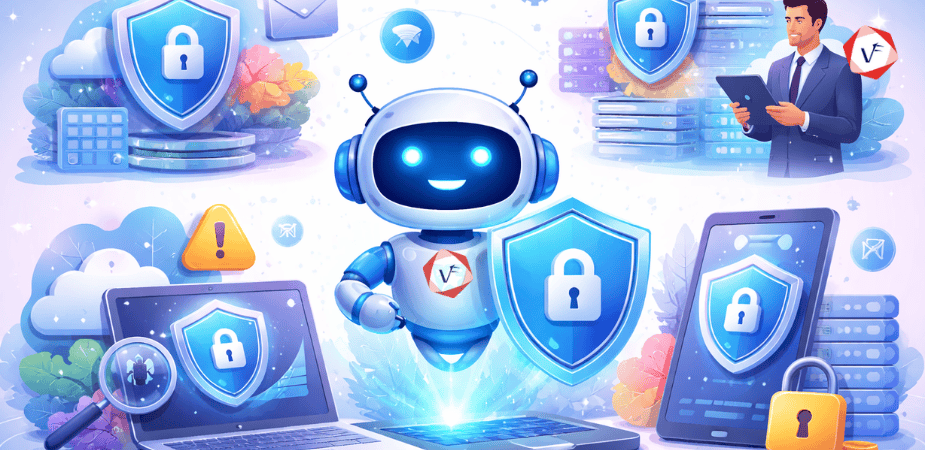
A few months ago, a finance director at a mid-sized company received a voice call from someone who sounded exactly like their CEO. Same cadence, same accent, same slight verbal tics. The caller was asking to authorize an urgent wire transfer. The finance director hesitated — something felt slightly off — and called back through a different number. The real CEO had no idea what they were talking about.
That call was AI-generated. Completely synthetic. And it nearly worked.
Stories like this have been circulating in security circles for a while now, but they're arriving in the mainstream faster than most organizations are prepared for. The shift happening in cybersecurity right now isn't just that attacks are more frequent. It's that AI has made certain attacks faster, cheaper, and more convincing — and defenders are scrambling to apply the same technology to keep up.
This piece covers the AI cybersecurity trends that actually matter for businesses right now. Not theoretical future risks — the things showing up in real incidents and real security discussions today.
The old model of a cyberattack involved a lot of manual reconnaissance. Someone would research a target company, identify employees, figure out who had access to what, craft a believable pretext, and then execute. It was time-consuming. That time cost was, in a strange way, a kind of natural limit on how many attacks could happen simultaneously.
AI has largely removed that limit.
Reconnaissance that used to take days now takes minutes. Phishing emails that used to be generic — and therefore easier to spot — are now personalized using publicly available data about the recipient. The email references their job title, their recent LinkedIn activity, a project they're working on. It looks like it came from someone who knows them. Because the AI did the research.
Vulnerability scanning has accelerated similarly. Automated tools powered by machine learning can probe systems for weaknesses at a scale and speed that wasn't practical before. Once a weakness is identified, exploit attempts can begin almost immediately — without waiting for a human attacker to manually review the results and decide what to do next.
What this means in practice: the window between a vulnerability being discovered and it being actively exploited has compressed dramatically. The old advice of "patch within 30 days" is increasingly difficult to hold to when exploitation can begin within hours of a vulnerability becoming public.
There's no comfortable answer here. But understanding the speed change is the starting point for thinking about response posture differently.
The most useful thing about AI in security defense isn't that it can identify known threats faster. Signature-based detection has been doing that for decades. The genuinely valuable shift is that AI systems can learn what normal behavior looks like in a specific environment — and flag deviations from that baseline, even when those deviations don't match any known attack pattern.
Think about what that means practically. An employee whose account suddenly starts downloading large volumes of data at 2am, accessing systems they've never touched before, from an IP address in a country they've never logged in from — a traditional security system might not flag any of that individually. Each action, on its own, might be technically permitted. AI-based behavioral analysis looks at the combination, compares it to that user's history, and raises an alert.
Security Operations Centers using AI-assisted monitoring report being able to cover environments that no human team could manually watch at that scale. When you're talking about networks generating millions of log events per day, human review is simply not a realistic option across the full dataset. AI processes all of it, surfaces the signals that warrant human attention, and lets security analysts spend their time on actual investigation rather than log triage.
The limitation worth being honest about: these systems generate false positives. An alert doesn't mean a breach. Teams implementing AI-based monitoring often go through a tuning period where they're calibrating sensitivity — too high and analysts get buried in noise, too low and real threats slip through. That calibration process takes time and requires experienced people. It's not plug-and-play.
Zero trust isn't a product. It's a mindset, and it's one that the current threat environment is making increasingly hard to argue against.
The traditional security model assumed that if you were inside the corporate network, you were probably trustworthy. The perimeter was the boundary. Get past the firewall and you had meaningful access. That assumption was always imperfect. AI-powered attacks have made it genuinely untenable.
When attackers can mimic legitimate user behavior, when credentials can be obtained through increasingly convincing phishing, when lateral movement through a network can happen quietly over days or weeks — the perimeter stops being a reliable indicator of trust. Zero trust says: verify everything, every time, regardless of where the request is coming from.
In practice this means multi-factor authentication that isn't just a checkbox, least-privilege access that actually limits what each account can reach, continuous verification of sessions rather than one-time login checks, and network segmentation that limits the blast radius if a compromise does occur.
For businesses that haven't fully moved in this direction: the implementation isn't instant, and it does create friction. People find additional authentication steps annoying. Access restrictions generate complaints. That's real, and it's a legitimate management challenge. But the alternative — a model that assumes internal traffic is safe when AI-powered attackers are specifically designed to look like legitimate users — is no longer a reasonable position.
The story in the introduction wasn't a hypothetical. Variations of it have been reported in multiple countries, targeting businesses across different industries. The technology required to generate convincing voice deepfakes has become accessible enough that this is no longer an attack reserved for high-value nation-state targets. It's available to criminal organizations with far less sophistication than that.
What makes deepfake social engineering particularly dangerous is that it weaponizes trust. Security training has long told people to verify unusual requests. But that advice assumes "verify" means calling back or asking a question. When the voice on the other end sounds authentic and responds naturally to follow-up questions, the usual heuristics for detecting a scam stop working as reliably.
Video deepfakes add another layer. Executives joining a video call who aren't actually there. Job candidates in interviews who aren't real people. The technology isn't perfect — there are still tells for trained observers — but it's improving faster than most people's ability to spot it.
The defensive response involves a few things that are less technically complicated than they might sound:
None of these are foolproof. But they raise the cost of the attack considerably, and most attackers are looking for the path of least resistance.
There's a meaningful difference between reacting to a breach and knowing that one is likely coming. AI-powered threat intelligence systems are pushing more organizations toward the latter, though "predictive" is a word that deserves some healthy skepticism — it's not precognition, it's pattern recognition at scale.
What these systems do is aggregate information from sources that no human team could monitor comprehensively: dark web forums where stolen credentials and attack toolkits are traded, security research publications, breach reports, honeypot data, malware sample databases. They identify patterns in what's being discussed, what's being sold, what vulnerabilities are attracting attention — and surface the ones relevant to a specific industry or technology stack.
A business running a particular version of an enterprise application, for example, might receive an early warning that a vulnerability in that software is being actively discussed in attacker communities — before any public advisory has been issued. That lead time to patch or mitigate is genuinely valuable.
For smaller organizations without dedicated security teams, this kind of intelligence has historically been out of reach. The cost and expertise required to monitor these sources was too high. Several managed security service providers now package AI-assisted threat intelligence into their offerings, making some of this capability accessible at a lower entry point. It's worth asking about when evaluating security partners.
This one catches a lot of businesses off guard, because it's a category of risk that didn't exist a few years ago and isn't covered in most standard security frameworks yet.
When a business integrates AI into its operations — a customer-facing chatbot, an internal knowledge assistant, an automated workflow that reads and acts on documents — it creates new attack vectors that are specific to how AI systems work.
Prompt injection is the most discussed. An attacker embeds malicious instructions in content the AI system processes — a document, an email, a web page — causing the AI to take actions its operators didn't intend. Depending on what the AI has access to, this could mean leaking sensitive information, taking harmful automated actions, or being manipulated into providing incorrect outputs to users.
Model poisoning is a related concern for organizations training their own models or fine-tuning existing ones. If the training data is compromised, the model's behavior can be corrupted in ways that are difficult to detect from the outside.
These aren't theoretical concerns being raised by researchers in a vacuum. They're being actively explored by security professionals and, inevitably, by people with less benign intentions. Organizations adding AI to their operations need to treat AI security as part of their standard security review process — not as a separate, future concern.
Practically, this means understanding what data each AI system can access, auditing inputs that flow into AI systems for potential manipulation attempts, and maintaining human oversight for any AI-driven actions that have significant consequences.
There's a version of the AI cybersecurity conversation that implies technology will eventually solve the problem — that if defenses are smart enough, human error becomes less critical. I don't believe that, and I've watched enough security incidents to feel reasonably confident about it.
The most sophisticated security stack in the world doesn't protect a business where employees routinely click on links without thinking, share passwords, or assume that urgent requests from authority figures don't need to be verified. Social engineering, at its core, exploits human psychology. AI has made the pretexts more convincing, but the underlying vulnerability it exploits hasn't changed.
What has changed is that security awareness training needs updating. The phishing email with obvious spelling mistakes and a generic greeting is still around, but it's no longer the primary threat model. Training that only prepares people for crude attacks leaves them unprepared for personalized ones, for voice deepfakes, for the scenario where the "CEO" sounds completely authentic on a call.
The businesses that consistently do better on security incidents tend to share a cultural trait: they've made it easy and acceptable for employees to slow down and verify. The finance team member who questions an unusual payment request doesn't get criticized for causing a delay. That culture is harder to build than any technical control, and it's harder to buy. But it's one of the more durable defenses available.
The gap between "we have security measures" and "we have security measures that address current threats" is wider than most businesses realize until something goes wrong. At Vofox Solutions, our cybersecurity services are built around what's actually threatening businesses right now — not generic frameworks divorced from the current threat landscape. From security audits and vulnerability assessments to ongoing managed security support, we work with organizations across industries to close real gaps before they become real incidents.
Let's start with an honest conversation about where you stand. Explore our cybersecurity services or reach out directly to talk through your situation.
Attackers use AI to automate vulnerability scanning, craft personalized phishing emails at scale, generate convincing deepfake audio and video for social engineering, and adapt malware in real time to evade detection. The speed and personalization that AI enables has significantly raised the effectiveness of attacks that previously required substantial manual effort — which means attacks that used to be reserved for high-value targets are now running against much broader populations.
Defensive AI systems monitor network traffic and user behavior continuously, detecting anomalies that rule-based systems miss because they don't match any known attack signature. They can identify threats in real time, correlate signals across large environments that no human team could manually monitor, and respond to incidents faster than traditional security operations allow. AI is also used for vulnerability management — predicting which weaknesses in a given environment are most likely to be actively exploited based on current threat intelligence.
Zero trust is a security model that operates on the assumption that no user, device, or system should be trusted by default — even inside the corporate network. Every access request is verified. This matters for AI threats because AI-powered attacks are increasingly capable of mimicking legitimate users and bypassing perimeter defenses. Zero trust limits the damage even when an initial compromise occurs, because the blast radius is contained by strict access controls.
Deepfake attacks use AI-generated audio or video to impersonate executives or trusted individuals — typically to authorize fraudulent transactions or extract sensitive information. Defense involves establishing out-of-band verification procedures for high-stakes requests, training employees specifically for these scenarios (not just generic phishing), creating a culture where slowing down on unusual requests is accepted regardless of apparent urgency, and maintaining healthy skepticism even toward familiar-sounding voices on unexpected calls.
Yes, and the reason is somewhat counterintuitive. AI has made certain attacks cheaper and easier to run at scale, which means small businesses — once considered not worth the manual effort to target — are now attacked more routinely. Automated phishing, credential stuffing, and ransomware campaigns run against thousands of targets simultaneously. Small businesses are often more vulnerable than large ones because they have fewer dedicated security resources while facing a threat environment that has largely caught up with them.
Prompt injection is an attack where malicious instructions are embedded in content that an AI system processes — a document, an email, a web page — causing the AI to behave in ways its operators didn't intend. For businesses integrating AI into customer-facing or internal workflows, this is a real concern that belongs in the standard security review for any AI system being deployed. The risk depends on what the AI has access to and what actions it can take.
AI-powered threat intelligence systems aggregate and analyze data from sources no human team could monitor comprehensively — dark web forums, security research, breach reports, malware samples — to identify emerging attack patterns before they're widely known. They give security teams earlier warning of threats targeting their industry or technology stack, allowing more proactive defense. This kind of intelligence was historically available only to large organizations; managed security providers now package it into services accessible to smaller businesses.
Start with the fundamentals: regular security audits, up-to-date patching, multi-factor authentication across all critical systems, and employee training that covers modern social engineering tactics including deepfakes — not just obvious phishing. From there, consider AI-assisted monitoring tools appropriate to your scale, establish clear verification procedures for high-stakes requests, and if you're integrating AI into your operations, treat AI security as part of your standard security review process rather than a separate future consideration.
The uncomfortable truth about AI and cybersecurity is that the same technology improving your defenses is improving the attacks against you. It's not a problem that gets solved. It's a dynamic that gets managed — better or worse depending on how seriously an organization takes it and how current their understanding of the threat landscape actually is.
The businesses that navigate this well tend to share a few traits. They treat security as an ongoing practice rather than a one-time project. They update their threat models when the threat landscape changes rather than relying on what worked three years ago. And they invest in the human side of security — culture, training, and verification habits — as much as in the technical side.
None of that is as simple as buying a product. But it's what actually moves the needle. The technology matters. The mindset around it matters more.
Guaranteed Response within One Business Day!
Why Businesses Are Choosing Software Outsourcing Companies in India for AI Development
The Role of Generative AI in Modern Software Outsourcing
The Role of AI in Modern UI/UX Design
How AI Is Transforming UI/UX Design and Development in 2026
What Is Agentic AI? A Complete Guide for Businesses

Guaranteed Response within One Business Day!